Windborn: Driftwood in motion at ArtPrize 2025
Jennifer Wack’s Windborn brings time-worn driftwood together as a horse caught between stillness and motion, carrying the shoreline into ArtPrize 2025.
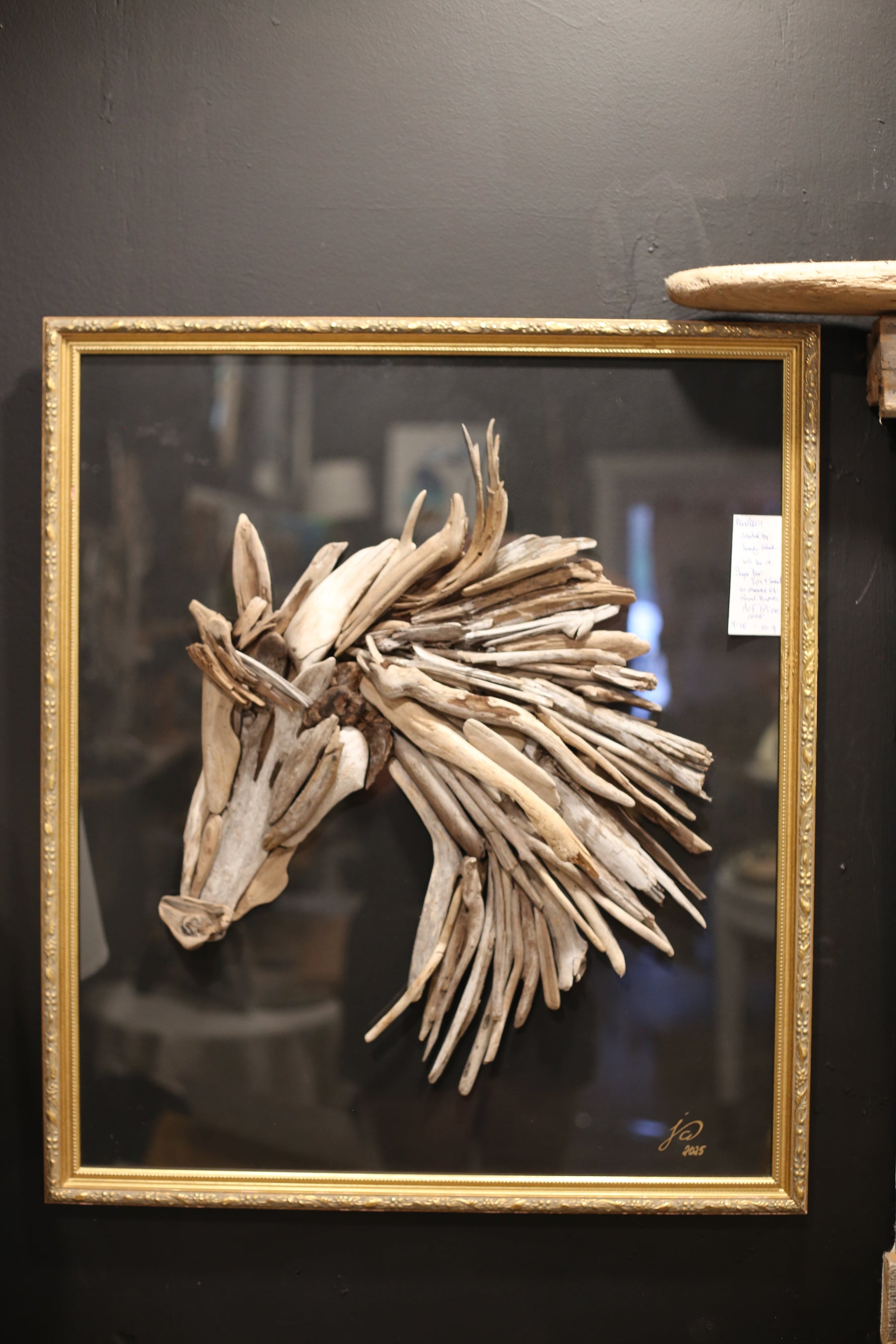
From across the room, Windborn reads as a horse already in motion. The muzzle drops, the neck turns, and a mane of pale driftwood sweeps backward against a dark field. Move closer and the animal resolves into dozens of separate pieces: split branches, softened edges, knots, grain, and curves marked by water and weather.
The shoreline remains visible
Jennifer Wack’s original description of the work begins at the water’s edge, where time-worn driftwood carries what wind and waves have done to it. Windborn does not hide those histories. Long pieces establish the horse’s face and neck; shorter fragments gather around the eye; branching forms fan outward through the mane. The work holds together as one clear silhouette while allowing every piece to remain recognizably itself.
A moment of wild grace suspended in motion.
Jennifer Wack on Windborn
Built to be seen twice
That double reading gives the sculpture its tension. First comes the horse: alert and almost ready to move beyond the frame. Then comes the material: driftwood that still looks found rather than manufactured. The form feels deliberate without sanding away the irregularity that gives each piece its character.
It is the same pleasure that brings many people to a Lake Michigan stone. A Petoskey stone can look quiet when dry, then reveal a field of fossil pattern under water. Leland Blue carries a color and industrial history that only appears after a closer look. Windborn works at a different scale, but it asks for the same pause: see the whole, then look again at what it is made from.
Windborn at ArtPrize 2025
Jennifer exhibited Windborn during ArtPrize 2025 in Grand Rapids. The sculpture was shown at Sugar Bar: Sips and Sweets, 132 Monroe Center Street NW, during the September 18–October 4 citywide event.
Moving the work from the Trading Post to ArtPrize changed its setting, not its point of origin. The shoreline is still present in every weathered edge and pale length of wood. What began with shapes carried in by water became a public work meant to reward both an immediate impression and a slower look.
A larger expression of the Trading Post
Most of the work at the Trading Post can be held in one hand: a stone, a pendant, a reference card, a piece ready for the wheel. Windborn expands that material attention into something larger. It shows what can happen when a found object is not treated as raw material to erase, but as the beginning of the form.
That idea runs through the shop, the classes, and the learning work Jennifer and Scot continue to build: look closely, learn what is in front of you, and imagine what it might become.
See where Windborn fits in Jennifer and Scot’s story, or ask the Trading Post about the artwork.